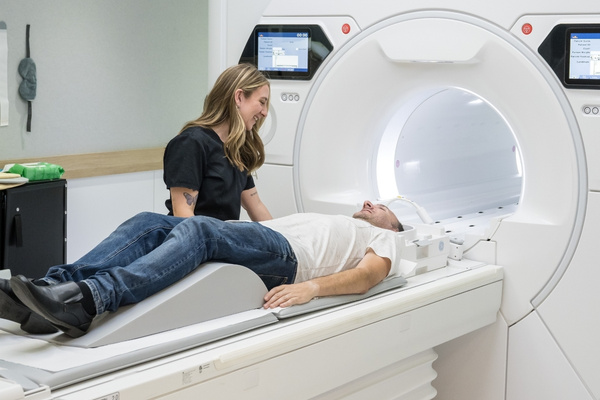
What makes my pacemaker suitable for an MRI scan?
There are several factors that influence MRI suitability:
- Requirements relevant to your specific heart condition
- The manufacturer’s specific MRI conditions
- The make and model of your pacemaker
- The type and model of the leads connected to it
- Whether the complete pacemaker system is MRI-conditional
- The strength of the MRI scanner (measured in Tesla)
- The presence of additional, abandoned, damaged or unusual leads
This is why two people with the same pacemaker may be given different advice about having an MRI scan.
What does MRI-conditional mean?
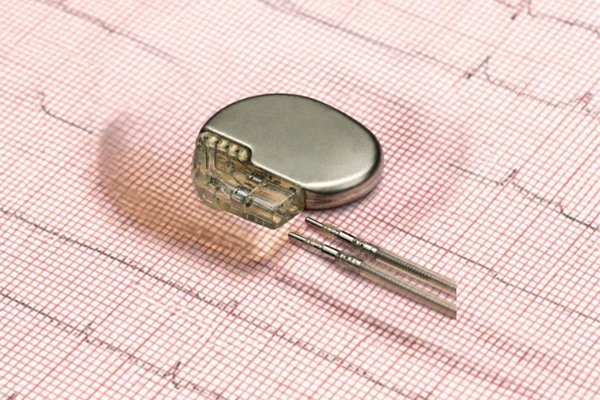
Your referrer may describe your pacemaker as MRI-conditional. This means your implanted device can be scanned under specific conditions set by the manufacturer.
These conditions usually apply to the complete pacemaker system, including the pacemaker generator and the attached leads. This means the combination of components will need to be checked because a compatible pacemaker connected to non-compatible leads may not meet the conditions for a scan.
What if my pacemaker isn’t MRI-conditional?
Selected patients with non-MRI-conditional pacemakers may still be able to have an MRI in specialised centres following individual assessment. This would depend on the patient’s heart condition, device characteristics and monitoring required. However, in most cases, alternative imaging tests would usually be considered and discussed by your referrer.
How will I know if my pacemaker is MRI conditional?
Start with your pacemaker identification card. This usually contains information about your pacemaker and the leads, as well as the manufacturer and model details. It’s advisable to keep this card where it’s easily accessible, like in your wallet, and take it along to medical appointments.
If you don’t have your card or aren’t sure what type of pacemaker you have, reach out to your cardiologist or the cardiac device clinic that cared for you. They may have your device information on record.
Bear in mind that MRI suitability isn’t just determined by the manufacturer’s name. The model, leads and your individual heart condition all need to be considered too.
Does MRI strength matter? Understanding 1.5T and 3T MRI
MRI scanners are often described as 1.5T or 3T. The “T” stands for Tesla, a unit used to measure magnetic field strength.
A 3T MRI has a stronger magnetic field than a 1.5T MRI scanner. Both produce detailed medical images, but the different magnetic field strengths matter when you have a pacemaker.
Some MRI-conditional pacemaker systems are approved for MRI scans on both 1.5T and 3T, while others have approval under particular scanner conditions or at specific magnetic strengths.
Knowing whether your pacemaker is ‘MRI-conditional’ or ‘non-MRI-conditional’ is only part of the answer. Your imaging provider will still need to confirm that your pacemaker system is suitable for the specific MRI scanner and the scanning conditions being used.
How does an MRI affect a pacemaker?
MRI uses a powerful magnetic field, radiofrequency waves and rapidly changing magnetic fields to create images. All of these can interact with a pacemaker. Potential effects include changes in how the device senses or paces the heart, electrical current within the leads and heating near the lead tip.
Modern MRI-conditional systems are designed to reduce these risks when used according to their specifications and protocols.
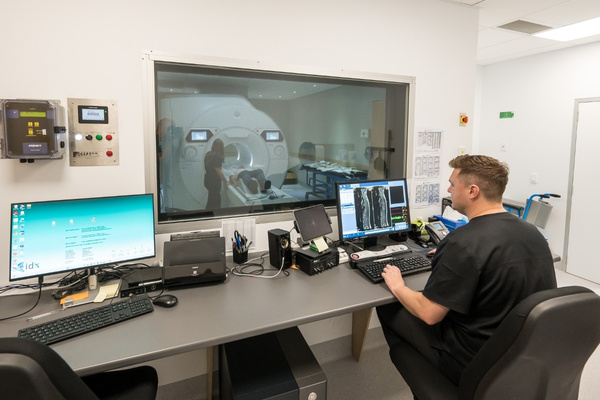
In addition, specialised monitoring equipment is required for clinics that scan patients with pacemakers. There may also be a preference to perform these MRI scans in or near a hospital setting where additional clinical support is readily available if required.
What should I tell my doctor when I’m referred for an MRI?

Let your GP, specialist or allied health professional know that you have a pacemaker when they refer you for an MRI. If possible, ask them to include the following information with your referral:
- Your pacemaker identification card
- The manufacturer and model of your pacemaker
- Information about your pacemaker leads
- When and where the pacemaker was implanted
- The name of your cardiologist or cardiac device clinic
- Details of any pacemaker replacements, lead changes or procedures
The more information you can provide, the quicker it will be to organise your appointment at the most suitable MRI location.
What should I tell Sunshine Coast Radiology?
It’s important to let us know you have a pacemaker when you make your appointment, rather than waiting until the day of your scan.
We’ll ask you to provide the following information:
- Make and model of your pacemaker
- Pacing lead details
- Implantation date and any changes made to your device
- Your cardiologist’s details
This allows us to verify your complete pacemaker system, check the manufacturer’s MRI conditions and liaise with your cardiologist on the completion of the form specific to your device before making your appointment.
What happens before, during and after an MRI?
The process will vary depending on your pacemaker and your individual health needs. Your pacemaker is usually checked before your MRI, and depending on the type of device, it may be temporarily programmed to a device-specific mode before the scan.
During the scan, your heart rhythm and other vital signs will be closely monitored. Our team is highly trained and will guide you and care for you throughout the process. Once your scan is completed, your pacemaker will be checked again, and if needed, the settings will be adjusted.
These extra steps and precautions are part of the reason an MRI for someone with a pacemaker may require more planning than a standard MRI appointment.
Frequently Asked Questions
Will I feel anything during the MRI?
Can I have any body part scanned?
Will my pacemaker stop working during the MRI?
Why does the process take longer than a standard MRI?
MRI-conditional systems are designed to work during an MRI scan under specific conditions. Device checks and programming protocols are used to help ensure the pacemaker works appropriately before, during and after the scan.
Additional preparation, device verification, monitoring and post scan assessments are often required for patients with pacemakers.
Can I have an MRI if I have a defibrillator (ICD)?
Sunshine Coast Radiology MRI with team
Some implantable cardioverter defibrillators (ICDs) are MRI-conditional and may be suitable for scanning under specific conditions. Like pacemakers, suitability depends on the device, leads and manufacturer requirements. Our team will review this information before your appointment.
How can Sunshine Coast Radiology help?
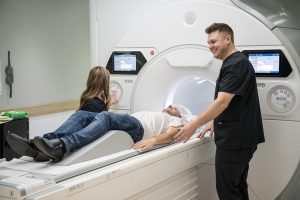
Sunshine Coast Radiology supports MRI access for patients with pacemakers through a dedicated process of assessing pacemaker suitability and collaboration with cardiology teams. Once your suitability for an MRI scan is determined based on your specific device, clinical requirements and manufacturer conditions, we’ll book you in at our Sunshine Coast University Private Hospital clinic at 3 Doherty St, Birtinya.
If you don’t have a pacemaker and simply need to book a scan, we have a Medicare licensed 1.5T MRI at our Beerwah clinic and Medicare licensed 3T MRIs at:
- Maroochydore, 49 Baden Powell St
- Maroochydore, 60 Wises Road
- Caloundra, 67 Bowman Rd
- SCUPH, 3 Doherty St, Birtinya
With unlicensed 3T MRIs at Maroochy Private Hospital and Noosa.
Read more about why some MRIs are bulk billed and others not.
If you’re being referred for an MRI, tell your referrer that you have a pacemaker and provide as much information as possible. When you’re ready to book, let our Bookings Team know about your pacemaker so we can make your assessment process and booking as smooth as possible.